Showing posts with label Candling. Show all posts

Friday, 8 March 2013

More hatching eggs!!!

Croad Langsham chick
As if I would be able to put the incubator away for any length of time.  As it happens it was only 5 days or so and yes I have more hatching eggs.  This time the eggs were kindly donated by Hillside Pigs in the Vale of Glamorgan, South Wales.  Most unexpected but when I knew they were Vorwerk and Crested Legbars I could not really say no!


I tried to hatch a Legbar recently but the egg was not fertile, so this is a great chance to try again and the Vorwerk's are, I think, stunning looking birds and they lay light cream colored eggs.  Contrast with the blue of the Legbar and the dark eggs from my speckeldy it will make a lovely box of 6 eggs.


Candling egg
This is something I am actually keen on trying to grow and develop.  I know the free range home reared eggs taste much the same whatever the colour, but to be able to offer free range local multi coloured eggs would be a little different and a little unique.  Add to that the offer of quail eggs and duck eggs, I'm starting to build a picture in my head of something I would like to get involved with!

Enough day dreaming, this hatch will only be 4 eggs, 2 Vorwerk and 2 Crested Legbars.  

I have decided not to add to the 4 at the moment as I am still in the process of building my run enclosure down the allotment, plus I think my wife may just kick me out!
When I returned with the eggs I was met with a "I though we were getting rid of the incubator for a while"!
Ooooops!  Could be worse I suppose especially if I have turned up with a baby Lamb or something similar! :-)
The allotment is key really, whilst I made great progress a few weeks ago, other commitments have stopped me from getting down there to finish the job however I still think I will be ok to complete by end of March!


Vorwork - Photo from www.brbpoultry.co.uk
I have fancied Vorwerks for a while, they are lovely looking birds.  There were suposedly developed in 1900 by a German poultry breeder Oskar Vowerk and was standardised in 1913.  There is a bantam version which was developed later in America in 1966.
They seem a little scarce to me, which is a shame as they are lovely looking birds.
Hers hoping I am successful with my hatch.

Thanks for reading.

Thursday, 14 February 2013

Incubating Eggs day 7 again!

Pair of Wyandottes creating a heart shape!
Well I have been away for a few days in London and that meant leaving the incubator running without any monitoring for 3 days.  I did realise this would happen when I set the eggs back on 7th February, I knew it was a bit of a risk, but I was impatient probably due to the failure of the last batch.


Today, Valentines day, is the 7th day so I have been candling the eggs to check for development.  The great news is that at present 11 out of the 12 eggs I set appear to be fertile.  The one egg that appears not to be developing is unfortunately the Cream Legbar which is a shame however it does mean that there is potential for Croad Langsham, Owl Beard, Salmon Faverolle and Silver Lace Wyandottes hatching out in around 14 days.

What did I do differently to my first batch?
Well I'm not going to take all the blame or credit here as I have had loads of useful advice from Andrew from Slate House Farm and from Norfolk Bantams on Twitter, in fact, without their help I may have delayed my next hatch for some time.  There is also the consideration that maybe the eggs were not quite ready as it was so early in the year.


I think I took the instructions with the incubator quite literally with regards humidity.  It stated that one water trough should be filled and two should be filled at day 18. The instructions did not mention anything about ventilation either and I don't recall reading about this, but it is crucial when controlling the the humidity. Ultimately I think I drowned the chicks or prevented them from developing properly which is very sad and a mistake I will never make again.

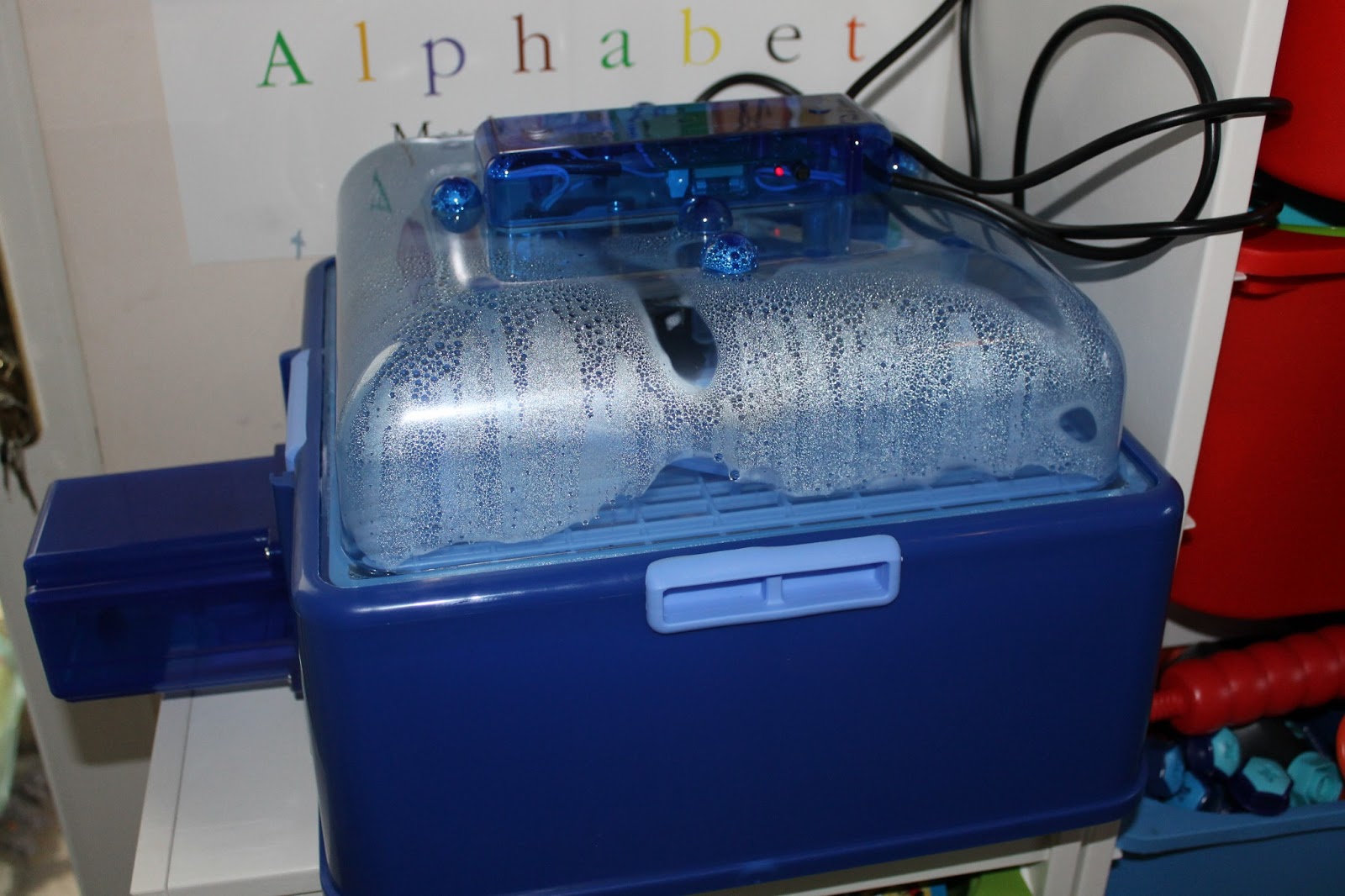
Secondly, I did not monitor humidity, I had no way of knowing what the relative humidity percentage was at any time.  But again looking back I think levels were far too high.  The condensation on the roof of the incubator was a big sign that I totally missed.


To correct both of these major mistakes I have bought myself a reptile humidity gauge for £5.99.  Why these are not fitted or provided when you buy a Corti incubator I have no idea, but it is an essential piece of kit in my opinion.  I have also worked out how to open the vent holes in my incubator.

You do learn by your mistakes, and it has been a big mistake and quite a large learning curve.  It is almost addictive, learning and putting into practice what you have learnt.

Before setting my current batch of eggs, I ran the incubator for 2 days monitoring humidity.  I ran it initially with no water.  Humidity was as low as 10%, so there was no chance of adding the eggs without water.


Once one water trough was filled the humidity increased, first to 30%, then a few hours later 40% and the next morning it was stable at 50%.

The incubator has continued to remain at 50% with a full water trough and vents fully open.  11 of the 12 eggs are developing so its good news for now.


I will be monitoring carefully and will post more updated soon.


Thanks for reading.

Saturday, 2 February 2013

Day 24 of hatching and a review of incubating

It's day 24 of the silver Wyandotte incubation period.  Despite checking three or four times a day, there is no change.  Not that it will make any difference how often I check.

I am starting to think that the remaining two eggs are not going to hatch. It could be a variety of reasons, so i thought it may be useful to write about some of the factors that can affect a hatch in an incubator.


  • Time of year - hens will not naturally sit or go broody at the moment, spring is on its way, so hopefully a later attempt in middle of February will be more successful.  There is of course the possibility that the cockerel is not quite firing on all four cylinders, he may of course still be in hibernation mode.
  • Quality of eggs - there is no doubt in my mind that quality at this time of year will not be as good.  The shells can be quite porous due to the feed being eaten being used by the hens for heat and new feather growth rather than producing eggs.
  • Temperature of incubator and position - I have been told and read that even half a degree can result in late hatching and it could even result in a failed hatching.  It is also important to consider the location of the incubator.  If kept in a drafty position or somewhere that temperatures and humidity can fluctuate it can put strain on the incubator and even though they are designed to keep a constant temperature, it could result in subtle drops in temperate for short periods inside.
  • Calibration of the thermometer - this is something I have not checked.  One way of checking you thermometer is working is removing from the incubator, and putting it in a bucket of ice.  This way you can check if it is reading 0 degrees.  If not, you can adjust your setting to reflect this.  The only problem with this method is that my incubator does not have a full thermometer in it so it would not work in my case.  I will just work on the basis it is set correctly.
  • Humidity - in the UK it is certainty more critical in the last 3-4 days to get this correct.  I have recently heard of dry incubating, where the eggs are set without the use of water as we have high humidity in the UK.  Water is only used in the last 3-4 days when he increase in humidity is required.  I used water all the way through my incubation.
  • Frequency of turning - I have an auto turning incubator, but if you don't and need to manually turn the eggs, its critical to turn at least 3 times a day, most suggest turning 5 times a day.  If you turn manually you need to ensure you mark the eggs so you know they have been turned.


Of course you can avoid all of this by using a broody hen, but who knows when a hen will go broody, and you are limited to 6-8 eggs depending on breed type.
Plus where is the fun and learning experience!

Thanks for reading

Tuesday, 29 January 2013

Naughty naughty

So, I have done something I shouldn't.  

I candled the remaining 2 eggs last night.  Most suggest this is a bad idea.  I have never candled so late before so why now?

Well I have had concerns for a while that the 2 eggs are not progressing well.  The air sacks seem too big for my liking.  However I will let them continue until at least 23 days just to make sure.
I guess I just could not resist checking.  This is my first time using an incubator, all previous hatches have been under a broody hen, and no sane person is going to try and remove a broody from their nest in the last 2-3 days.  


They sit tight and defend their nest with that prehistoric beak!  Its a little like the final scene in Zulu!  
Plus it hurts and I have been given enough wounds in the past so would do everything to avoid this.
However in the incubator there is not a crazy hen trying to peck your finger off your hand, you can just lift and check.  Naughty naughty.

I will have to sit tight now and wait.  Its day 20 out of 21, so not long.

More updates to follow tomorrow - official hatching day! :-)

Sunday, 27 January 2013

Wyandotte hatching update day 18

Day 18 of the hatching of Silver Lace Wyandotte Bantams in the new incubator is proving to be exciting, for me anyway!


Hatching egg, candled at 18 days
I candled the eggs again last night and saw what I am hoping is a chick, moving around in the egg.  The photo is to the left and you can quite clearly see the blood vessels.
There are some quite strange air sack shapes going on in both of the remaining eggs.  I hope this is not a bad sign.

As it is 3 days before hatch, I have removed the 4 non-fertile eggs and the dividers separating the eggs and the auto turning mechanism has been turned off.
It is recommended to increase the humidity for the hatching period.  I had no idea how to do this until I read Katie Thears Incubation, A guide to Hatching and Rearing book and the instructions that came with my incubator.

Apparently you may not necessarily need to add more water but just reduce the temperature by half a degree to 37 degrees c and this increases humidity.


My Incubator manual also helped my understand things a little clearer.  Its not the level of water in the incubator dish, but the surface area of water.  So if you fill two dishes with water a quarter full each, it will produce higher humidity than if you fill one dish to the full capacity!

So, I am still clinging onto a little hope that the two remaining eggs will hatch.  If they do, it will go a little way in helping me set up my little project of breeding pure breed poultry, 1) to ensure their survival, 2) for fun and 3) to encourage other chicken keepers or want to be keepers, that pure breed is an option over hybrid birds.


Wyandotte Goldlace bantams at 14 weeks

Here are a few photos of the Gold Lace Wyandottes, taken more recently in the snow!


Not happy hens on the snow

I seem to be getting as addicted to taking photos as I am keeping hens and hatching chicks!  Nevermind!  Could be worse!


Wyandotte Chick with mum

I resisted the urge to drone on about it.  The hens did not like it at all but I quite enjoyed our little wintry spell.  Certainly made a change to all the mud!


Hens and chicks, sheltering from a hail shower

In the last half hour we had a heavy hail storm.  I had let the Chickens our earlier in the day.  Seems the boys climbing frame has another use in the winter!


Thanks for reading.

Sunday, 20 January 2013

Candling Eggs on day 11


Excitement, enthusiasm, anticipation!  Words that I would used to define how I felt when I received my hatching eggs through the post back on the 10th January.

There is something special and addictive about hatching chicks.  Sadly my hatch rates have never really been high.  My first attempt under Treacle my Speckledy hen resulted in just one chick hatching out of 3 eggs.

The second attempt in October 2012 resulted in two chicks hatching out of 6 eggs, again under Treacle!

My third hatch is in my new incubator. A Corti AF25 - the automatic turning model.
I set the eggs back on 9th January and candled as recommended on the 7th day.  Being relatively inexperienced at candling, I was happy to leave the eggs for a further few days before discarding any that are unlikely to hatch.

I candled the eggs again tonight the 20th January at 11 days and took photographs of each egg.  I think this may be a useful guide for anyone candling their own eggs.  Apparently you should not candle to often and for too long! So here goes with the photos!


One of my own chickens eggs - Not Fertile


First incubator egg - not looking too promising - I would say this is NOT fertile.


Second Egg - something defiantly going on in this one - good to leave   in the incubator.


Third egg - Not Fertile! :-(


I cant go on really, sad that only one other egg below seems to have something going on. 
2 out of 6 again!!


Hopefully the other fertile egg!


Lets hope the two do hatch and there are no complications.

Thanks for reading! 

Saturday, 20 October 2012

Wyandotte Chicks Hatching

I was very pleased to see that one egg had hatched, so much so I actually bounced into work which has not happened for a long time.  

I could not get a photo yesterday morning.  The camera on my phone is not great, so when I returned in the afternoon, I took Rhys (my three and a half year old son) to see the chick as he was very excited.
With a little help we managed to get a photograph of the chick.  See right.

A very cute Wyandotte Black Lace Bantam.

Whilst out with the hens, I decided to watch Treacle for a while.  I noticed that one of the eggs had rolled out from underneath her and there was a crack in the egg. 

I managed to move the egg to the front of Treacle hoping she would pull it under her again for warmth, but she seemed to just watch it.


To my surprise I heard chirping and the egg started moving.  The chick was actually hatching.

I had my phone with me so I took a chance with the video.  See below.
Before you view it, a word of warning it is quite short.  As the chick started breaking through, Treacle pecked at it.  So I decided it would be best for me to tuck it under her.  She accepted it.  I have not edited the video.


So that is two out of six Wyandotte eggs that have hatched.  I have checked regularly and at about noon on Saturday 20th October, Treacle left the nest for the first time in approximately two days.  This is normally a pretty good sign that all hatching has finished.

I candled the eggs with an LED torch I have.  Two of the four un-hatched eggs appeared to have died very early on in the first couple of days.  One I believe was not fertile and the last I think died as day 15-17.  It's a shame but these things happen.

Chart from Avianweb.com
Image 7 shows the air sack according to number of days

For now I have disinfected the run with Stalosan F and will move it on Sunday to fresh grass.  I don't want coccidiosis which is a nasty parasite infection that can kill chicks in a few days.  Symptoms are chicks hunched up and blood in their droppings.
The photo below is of the two Black Lace Wyandotte chicks with Treacle.
They are tiny little things even compared to the Rhode Island Red chick I hatched earlier in the year.


I am becoming a little obsessed with hatching chicks and keeping chickens in general so watch this space! ;-)

Soon I will be posting my thoughts on the various old wives tales for breaking a broody hen and posting pictures of the new clean run for my other hens, Custard and Pudding.

Thanks again for reading.

Sunday, 14 October 2012

Broody Speckledy Hen Update Day 19

Rhode Island Red chick
Its 2 days and counting until we hope to hear the sound of chirping from the broody coop. 
It could of course be sooner.  The Rhode Island Red (left) that Treacle hatched 3 to 4 months ago arrived a day early.  Fortunately I had already bought a small pack of chick crumbs just in case.


The chicks apparently survive on the last of the undigested yolk in the stomach for 24 to 48 hours so in theory you could buy the food after the chicks have hatched, but I am concerned that the chick will try and eat the layers pellets in the run that Treacle has been eating.  The high calcium content in the layers can apparently kill the chick.  So I will be off to the local shop in the next day or two and will start feeding Treacle on the chick crumbs.  It will help her get back into condition quicker as it is higher in protein.
Treacle with quite a pale comb
I have also noticed that she is getting a little smelly.  I know chickens honk at the best of times, but she seems to have really let herself go this time in order to look after the eggs.

Broody hens can look quite ill and anaemic, so anything I can do to help her get back in to shape I will start as soon as I can.  I expect I will be buying poultry spice and poultry tonic as well as the chick crumbs.
No, before you say anything poultry spice is not the chicken version of old spice!  Its a mixture of spices like ginger that is in powder form that you add to the food.  Gives them a bit of a helping hand if feeling low and is worth giving in the winter time.

day 19 - photo from backgardenchickens.com
I tried candling the eggs the other day, but as the eggs are quite pale I could not see a lot.  That said I think at least one of the eggs seems to be progressing well.
Fingers crossed in the next 3 days I will be reporting hatchings with photos if possible.

Good luck Treacle!

Thanks for reading.