Monday, 24 June 2013

Egg hatching day 18

Fertile egg
The excitement is building.  Doesn't matter how many times I do it, under a broody or in the incubator.  The last few days of the incubation period are always exciting.
I am at day 17 out of 21.  Close to the point at which the humidity is increased and the turning of the eggs stop.

It is this stage that I find fascinating, with the chick developed enough to be manouvering inside the eggs ready for hatching, but the yolk still being absorbed into the stomach ready for the first 24-48 hours outside of the shell.

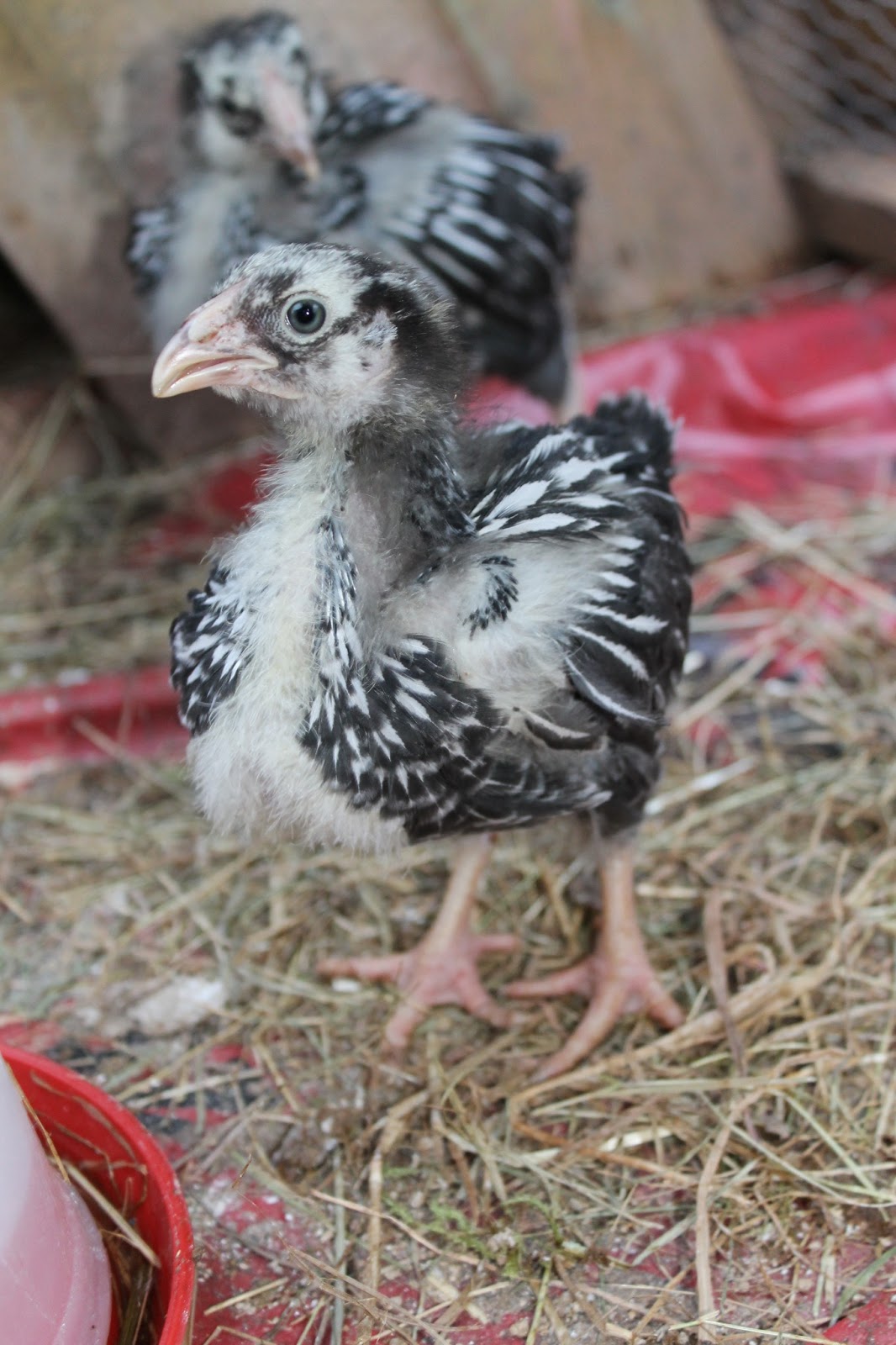
Silver lace wyandotte chick
They say the chick has an "egg tooth" perfect for breaking firstly into the air sack inside the shell at 19 days, taking its first breath, then through the tough shell that has protected it for the last 19 to 21 days.
I imagine if you could see in side the egg at pipping/ hatching, and increased the speed of footage it would be similar to a can opener taking the top of a tin of beans.
Inside that tiny cramped space, the chick pecks at the shell, rotating slowly, to break through, the top eventually falling off like that of a boiled egg.

Silver lace wyandote cockerels
That is just the beginning of an amazing transformation. For me it is the best part, run close by the moment around twenty weeks later when the hens lay their first eggs.

I hope in a few days to be reporting a successful hatch of araucana and silver lace wyandottes.

Watch this space for photos.

Thanks for reading.

Wednesday, 19 June 2013

If I stare at the incubator will they hatch quicker?!

My Silver Lave Wyandotte Hen and Cockerel
I'm at it again, without really planning that much either.  The problem is I can't resist, particularly the wyandottes and now the Lavender Araucana.

I have fired up the incubator again, all seems to be working well.  I'm gave the eggs 24 hours to settle after coming through the post.  Mark at Norfolk Bantams has kindly sorted me some eggs.  Last time I had 100% hatch rate.  So I am excited to see the results this time round.

I candelled the eggs on Sunday 16th June and there were 12 fertile eggs.  6 silver lace and 6 lavender Araucana.  I hope there is a good mixture of male and female in them.


Araucana cockerel 8 weeks
I currently have 3 male lavender Araucana from an earlier hatch, and 2 male and one hen silver lace from a previous hatch.  
This time I hope to be able to put a pair or trio together of both breeds.  Doing it this way, from hatching eggs, is a long process, but fun.  I'm certainly not going to be in a position to try and hatch any of my own eggs until next year.  Something to look forward to I guess.

My Croad Langshan Hen
So what now?  There is plenty to do.  I'm already planning another enclosure to take the extra chickens and then once I have reduced numbers sufficiently, it will be partially used for some ducks.  Welsh Harlequin I hope.  The other part, looking way ahead, maybe space for turkeys or more hens.


I still have one Silver Lave Wyandotte Cockerel for sale (Bantam) and in a few weeks the Lavender Bantam Araucana cockerels will be available too!

Thanks for reading and I will be back soon!


Tuesday, 4 June 2013

I'm so behind!

Hang on, it's June?!!  Where did May go?
I am so behind with the allotment it is untrue.  Having said that, the blog is looking very hit and miss too!
It looks like there will be no parsnips this year.  I have sown them in May before but June is going to be pushing it.

It's not just the vegetables I'm I a little behind with.  The breeding plan has taken a bit of a back seat recently.
The silver lace Wyandottes are now 13 weeks old.  They are looking like they have good lacing.  Legs are not as yellow as I would like so I will have to investigate how to improve on that.

The Araucana chicks are 5 weeks old, they look stunning and I'm really pleased with them, however it appears that they are all males. :-(
So there is only one thing for it and that's to hatch some more :-)
This hatch will be Araucana and silver lace wyandottes. These are the breeds I am concentrating on (bantam size) along with the croad langshan, again bantams.

I will be setting the incubator up again in the next few days in preparation for the arrival of the eggs.  Hatching at this time of year, I am looking forward to being able to out the chicks out a lot earlier (under heat) than I have previously.

I'm hoping at some point one of the hens will go broody.  I want to hatch some of my quail eggs, as a test and for replacements going forward.  I could use the incubator but it's nice to vary the hatching and there is nothing like seeing a hens with chicks.


Thanks for reading!

Wednesday, 22 May 2013

Send your Hens to work!


Have you ever taken over a plot or a piece of land that is overgrown? 

I suspect most 
of us who have an allotment have been in this position.  Ifyou are considering taking on an allotment, it would be good practice spending a considerable amount of time clearing the plot, or a section if it is a large allotment, even though the urge to sow and plant will be practically unbearable.

When I took on my allotment in 2008 it was overgrown, covered in wood,
 plastic fencing and chicken wire.  
Due to the size of the plot I have tackled it in sections.
We all look for ways of cutting corners and often they don't work, however I have been discussing an alternative with my allotment neighbour recently.
An army of hard worker goats could be very useful. I'm sure they would make short work of all the weeds and brambles.  You are however unlikely to get permission from your council or allotment association to graze a goat on the land, and there is no way you could be 100% sure that they would not escape and munch their way through all the lovely produce being grown by your neighbours.  I can see the eviction notice now!

Chickens!  
You may not be permitted to keep chickens on your allotment permanently, but if I use my situation as an example. I have a significant area that needs clearing but do not have time to clear it at present.
I have 3 fully grown hens in my garden at home.  It is feasible to take the hens to the allotment when I visit for an hour or two.  A cat box or cardboard box with ventilation would do the trick.  They can be let loose on the over grown area, even fenced in if required with some cheap netting and bamboo canes.

They will scratch, clear the plot, eat any bugs and slugs
 and fertilise as they go!
Now
 this is not a quick solution, and you certainly need to ensure that it does not stress the hens and that you have approval.  But why not give it a go.


Saturday, 11 May 2013

Another one bites the dust but the rest are thriving

I started to think I was doing something seriously wrong. It had only been one week since the last episode and they were a totally separate hatching group.
Why all of a sudden, my Wheaton maran decided it was time to flutter from the coop at 4 weeks old I still do not know.
I am starting to appreciate that symptoms are very similar for many of the poultry illnesses and unless you visit the local vets surgery for a postmortem you will never know.
An educated guess is the closest you can get and it is quite frankly frustrating.
The Wheaton was four weeks old, and so I expected to be past the most dangerous period, and having mysteriously lost 7 chicks a week earlier I was not expecting further losses.
All the symptoms pointed to cocsiodiccis

Ruffled, spikes feathers
Hunched posture
Shutting of eyes
Unstable on legs
Not eating and drinking very little

The only symptom missing was blood in the droppings.
However the crackle from the chest area when breathing maybe suggested a respiratory infection.

To avoid any further losses I am treating the chicks with Coxoid for 7 days. I will then follow with a tonic to give them a boost.

Fingers crossed and thanks for reading.


Wednesday, 1 May 2013

You need the lows to appreciate the highs!

What a day I had Sunday. I have been harping on about it for long enough on twitter now. I'm still no closer to knowing what caused it, but the potential reasons for the chicks I have been hatching all of a sudden moving on to the coop in the sky have increased. So I am putting it down to bad luck and will be keeping a close eye on future hatches.

I had 11 chicks in total, most were 2-3 days old. 3 gold lace Wyandotte chicks were recent hatches, they had fluffed up and so I added them to the brooder.
Long story short, one check all seemed fine, 30minutes later the gold lace were dead on their backs with 2 lavender Araucana staggering around and one silver lace wyandotte in a similar condition. I put them straight back in my incubator thinking it may have been a heat issue. Sadly they did not make it.

There are many theories including loss of heat, infection, bullying, fighting or maybe it was just a defect inherited from parents.

It's sad, but it is time to move on. I have 3 Araucana Lavender bantams and 1 silver lace Wyandotte bantam to add to the 4 silver lace hatched 10 weeks ago and 2 croad langshan.
I'm lucky to have these and hope the silver lace will be good enough to create a breeding trio from.
Looking forward, I am still fascinated by the Wyandotte, so I'm sure they will be on the agenda at some point again soon, but I'm thinking long and hard on what breed to hatch next.

I currently have 2 CLB females at 4 weeks old and I hope a wheaten maran to go with them, but what other pure breed would you add to this collection producing dark brown and blue eggs?

The leghorn has been suggested and I like this idea due to the white eggs that it lays. I also like the idea of Rhode Island Red. Great looking, good layers and of course a good size.
Some careful thinking required over the next few weeks is required.

I am also being drawn to ducks, specifically the Welsh Harlequin. I don't want many, just a drake with two ladies. To hatch or to buy a trio, that is the question. The other decision is how to provide a water source for them to bath in. Plastic paddling pool, trug, old bath?

Short term there is a pause in the hatching whilst I catch up on all the veg jobs I have been putting off. Main crop potatoes need to go in, carrots and parsnips need sowing, along with runner beans, butternut squash and sweetcorn.
It's amazing how in control you can feel in February and March, then all of a sudden it is 1st May, we hit the panic button and I find I sow everything at once and end up with a glut of veg.

Thanks for reading

Tuesday, 23 April 2013

Broody Bantam!

Croad Langsan Chick
Two days ago I was smiling smugly to myself. The 7 week old chicks were down the allotment, 3 week old chicks were outside under heat, the next batch of chicks are due to hatch in a few days, all five hens were laying, the asparagus starting to show and I was starting to imagine poached eggs on top of asparagus and toast for breakfast.

Today however, I discovered one of the Wyandotte bantam chicks I hatched approximately 6 months ago has gone all maternal on me. Yes, its broody bantam syndrome.

I should have realised sooner as she was spending more time in the coop than usual. When I returned from a night away, eight eggs had been pooled together neatly in the bottom of the coop. A perfect little spot for a bantam to sit.  Today I had to fight to get the two freshly laid eggs. At least she did not peck me, but she did look rather disgusted at being shoved off her nest area.

A final check on the undercarriage area confirmed the broody status, as she was free from feathers, plucked so neatly, I am sure in a past like she had been a beauty therapist.


My Bantam Goldlace Wyandottes
I have a few options I guess. I think any more fertile eggs may result in a divorce just at the moment, so I will try and encourage her to stop as soon as possible by collecting eggs frequently so she can not sit and if need be move her to her own little drafty cool coop/nest box for a few days. Something that has no bedding and lots of ventilation so that it cools her a little.


The other option is dunking her in a cold bucket of water (up to the neck I might add) but that does seem a little harsh as we are still getting some cool mornings.

Would be interesting to hear if anyone has any other ways of bringing a hen out of the broody cycle.

Thanks for reading.