Saturday, 14 September 2013

What's up Duck!

Lucky the crested legbar
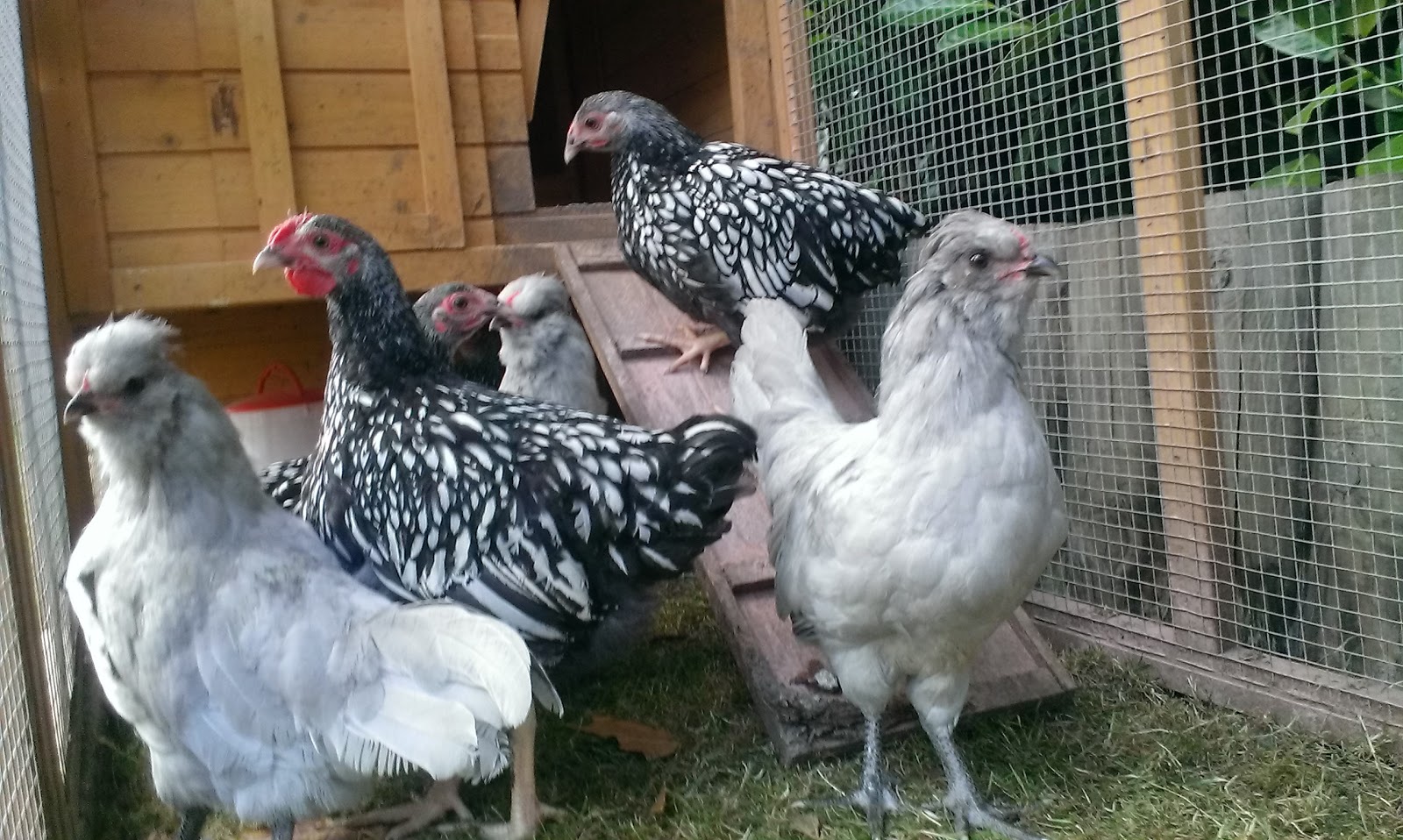
It's always useful to have something to concentrate or focus on when things go wrong. Settling the 10 week old birds back in to my garden at home and trying to integrate Lucky, the crested legbar hen that was left behind at the allotment has helped.

I have split the run at home on a temporary basis so that lucky has a small run and can see custard and the gang.  Her home during the day is a plastic box, which she seems to have taken to quite well, laying a lovely blue egg almost every day.

At night, she has settled onto a lovely routine, perching on the plastic box and then letting me pick her up, carry her to the hen house and pop her on a perch with the other hens.

There is no fuss or bullying as they are all rather dopey at night. Every morning I then have to collect her from the perch and carry her to her run.  Cute in a way but not something I fancy carrying on forever.  I just hope the integration will work.
The other distraction is Treacle the broody Speckeldy hen sat of 6 duck eggs.  Time seems to have flown by, as we are now on day 23 of 28.  I'm excited to see ducklings being raised by a hen, but I am a little nervous, as my lack of secure land is still an issue, and I fear that I will not find any in or near by my village.


Going forward the main project is finding land anyway possible, in the mean time, the back garden is turning into a poultry palace.

Thanks for reading


Tuesday, 3 September 2013

Chicken Theft South Wales - Cardiff

I would never have imagined I would be writing first hand about chicken theft.
It has been almost a year since I started my mini breeding plan for bantam silverlace Wyandottes, along the way I had picked up Bantam Lavender Araucana's, Bantam Croad Langshan's some crested legbar and a rather strange looking lavender Orpington.

The thieves took them all apart from 4 silver lace Wyandotte chicks and 4 lavender Araucana chicks at 8 weeks old plus a crested legbar hen at Point of Lay who from now on is called Lucky.

My show birds and planned breeding stock for next year are all gone and I bet it took the horrible, thieving buggers (toned the language down) all but 10-15 minutes to clear the pen.

Gutted is not the right word.  The shock is still working its way out and I don't think it has quite settled in yet.

It is not the monetary value of the chickens I am concerned about although I'm not happy, it is the impact on my boys who will be devastated that Colin the cockerel and his girls have gone.  I put lots of time and effort into hatching all the birds, looking after them and feeding them the correct foods.
They had a good life and were well looked after, now I don't know where they are or if they will be treated correctly or even slaughtered for meat.

Its almost a year since I had some difficulties and spent significant time off work unwell.  These animals gave me a boost, a purpose and a fantastic hobby, that even if I do say so myself was going very well.  It will not stop me, but I need to solve that long term problem of land and space to keep them.

I have reported the theft to South Wales Police, but to date I have not received a phone call or visit.  Any clues at the scene have no doubt disappeared.  So I have taken it into my own hands to start making enquiries, The local pub next door, my fellow allotment plot holders, I have even contact the local paper and I believe they are going to run a story on it and quote the crime reference number.
 
The chance of getting my birds back in practically nil, but you have to try.

The thieves knew what they were taking.  Whilst they stripped most of the point of lay stock they specifically took 2 of my lavender Araucana chicks that are 8 weeks old and that are almost certainly hens presumably to match up with one of the cockerels they stole assuming they were not related.

What next?  I am not giving up on keeping chickens and breeding Wyandottes, but due to the time of year I will be better starting all over again early 2014.  Gives me plenty of time to find a breeder with hatching eggs but more crucially find a small parcel of land to rent.

Thanks for reading friends and make sure you cheer me up with some nice chicken stories and pictures.
 

Saturday, 31 August 2013

Broody hen with duck eggs

Treacle, my broody hen is on day 7,sitting on 6 rather large duck eggs.  The Welsh Harlequin duck eggs are a fabulous size, lovely and clean and I hope, fertile.
I have never hatched duck eggs before, let alone under a broody hen so I have had to read up on ducks.

Firstly 28 days is a long time, I get quite impatient but hopefully it will be worth it, secondly, they have slightly different requirements in an incubator when compared to hen eggs, specifically temperature.

My research has suggested that these will not be an issue under a broody hen.  How then does she know to site for 28 days and not get off at say day 23 or 24 when she would perhaps naturally do so if  none of her own eggs hatch?  And does she somehow increase temperature and humidity?

I can't answer these questions, but it seems she just gets on with the job.
It is not an ideal time of year to try and hatch, in fact this morning, temperatures seem to have dropped.  I hope the hatch is successful and I will add more bedding for her to nest in to try and help with the dropping temperature.

Welsh Harlequin Ducks
Time will tell if I get chance to candle the duck eggs.  It will just be luck if I am there when Treacle leaves the nest.

As we head into September the quail are slowing down, with only two eggs daily, it's quite a shock to my boys who love them boiled as a snack. On the positive side, the hens at the plot are laying and providing a nice supply of bantam eggs.  I am still waiting for the crested legbar to lay.  They are now 22 weeks so I would hope they are on the verge of laying our very first blue eggs.
Fingers crossed.

Thanks for reading.

Tuesday, 20 August 2013

100% broody - signs your hen is broody

100% broody and 110% grumpy.  That is how I would describe Treacle the speckledy hen at the moment.
I had a close encounter earlier this summer but managed to avoid it. This time around Treacle will not be moved.  She is determined and will not be broken despite being locked out of her nest box daily for the last week.
I have had to move her to the broody coop as her antics were upsetting the other hens and my boys, as the egg supply was becoming erratic.  Combine the broody Treacle with a spot of egg eating and supplies in our household have dropped significantly.

Just in time the bantams on the plot have come to the rescue and have started laying, and they are laying well.  We are still waiting for the crested legbars to start laying, but at 21 weeks old it will not be long.  I think inspection of the nest box for blue eggs is the main reason for the boys insisting on coming with me to the plot on a daily basis.  It's nice they are that interested though.

Back to Treacle, and she has form.  Going broody this time last year, I gave in and purchased some goldlace wyandotte eggs.  Two hatched and they are now thankfully providing us with some lovely little eggs.  So do I give in again, and let her sit on eggs?  

I never thought I would say this, but I did have to think very hard.  I was not sure I wanted her hatching any more, this year anyway.  
I have a pen full (and more) on the plot, but it is hard if not impossible to resist the lure of hatching under a broody.
I have heard that chickens make great surrogate mothers for ducks, and I am keen to see how it works in practice.  
So there you have it, after a little searching I have 6 Welsh Harlequin duck eggs on the way from a breeder in Ammanford, Wales.

A few things to look out for to establish if your hen is broody.

1. Sitting in the nest box refusing to move.
2. Looking as though they are in a trance, staring at the wall.
3. Loss of condition, comb going pale, not looking after themselves.
4. Being aggressive and trying to peck you if you try and move her or retrieve the eggs.
5. Plucking out feathers on the chest area to line the nest and enable skin contact with the eggs.  

Thanks for reading.

Saturday, 17 August 2013

Home Farmer magazine article on quail

I have been privileged recently to have a piece of writing about keeping quail published in Homer Farmer magazine, a publication I have been following and reading for some time.  I find it has some great tips, information and recipies on all sorts of topics and projects that anyone with a smallholding or a backgarden can benefit from.

My article looked at the basics of keeping quail, and I have been very fortunate that the Home Farmer team have allowed me to publish the link to my article on my website and blog.  So you get to read part of the magazine FOR FREE!

Here is the link, have a read, you might just find yourself planning to keep quail and signing up to a subscription of home farmer.

Quail article link to Home Farmer quail article by Andrew Homer

Thanks for reading.

Friday, 16 August 2013

Quail hatching - the final stages

It's easy to get complacent, just pop the incubator on, buy some eggs and away you go.  I am usually good a planning my hatching and incubation periods, allowing for the postage time and the 24 hours of resting the eggs before setting.
Some how with my quail hatch I have managed to miss quite a significant issue.  Power cuts.
I would normally  be unlucky to have a power cut during our peak hatching season and the loss of power to an incubator for an hour or so would not be a total disaster and spell the end of the hatch.  If fact if the incubator is left alone and closed I'm sure the eggs will be unaffected.

Its not ideal but you have to work with what you have got. After all a hen naturally leaves her eggs daily for 30-45 minutes to eat drink and "clear out".


My issue is that we have building work on going and the power has been off for an hour the last couple of days.  School boy error but one I can not change.
 
The quail eggs are now into the last 3 days in the incubator.  Rather than risking further heat and humidity loss by candeling, I left well alone. I hope it helps and I will find out soon.
 
As with chicken eggs I have stopped turning and added more water to increase humidity ready for hatching.  The humidity should increase to around 70-75% now with the extra water and a slight reduction in temperature.

I hope to hatch a reasonable number of females.  I have massive demand from my three young boys, who will eat 6 quail eggs each as a snack.  They are lucky as with eggs priced at £2.85 locally for 12, we would not be buying them.

I will be sure to update once hatching is complete with photos of the new tiny chicks.

Thanks for reading.


Sunday, 4 August 2013

Quail hatching

So off I go again. The incubator is set and the 21 quail eggs are in position.   They are the courtnix type, a mix of white, light/golden, dark brown and the Japanese colour type.

Most incubators these days will allow you to hatch different breeds and my corti 25, which has proved very useful hatching chickens, states that it will incubate 50 quail eggs at a time.
The incubation period for quail is shorter that hens as 18 days, so to make sure I don't miss candling and turning off the auto turning mechanism I have made a calendar note.

Some suggest the humidity and temperature is slightly different to incubation hen eggs, but the reference books I am using require similar levels to chicken eggs.  I'm currently running at 37.5 degrees c and 54% humidity well within the ranges suggested.

You can candle quail eggs at 7 days as you do with all other egg types but the markings on the eggs can make this difficult, so I use my brinsea candler rather than a torch that has worked on some of my hens eggs.

This is my first time hatching quail eggs, hopefully not the last, but having been through the process several times before with hens I am feeling relatively relaxed about the whole process.
I have had a couple of enquiries locally for quail in particular males which is a little unusual but something that will be beneficial as no doubt there will be a significant number of males hatched.

My own quail eggs have been hatching out at 60-70% of all eggs set by local hatchers.  Ok but not the best hatch rate.  I did have 9 females to 2 males and this ratio may have been a little high with some suggesting 1 male to 3 female.  With the loss of a couple of females recently it has improved the ratio and I hope the will have a positive effect on the hatch /fertility rate.

I have recently written a piece for Homer Farmer on keeping quail, published in their September 2013 edition.  Whole books tackle the subject so I'm not suggesting this will tell you everything, in fact it is just a snippet of information.  But just as if you are going to keep chickens most important is to ensure you can provide the right type of continuous care and attention and to understand the commitment you are taking on, in addition talk to your neighbours about keeping them, especially if you keep the males.

Thanks for reading.